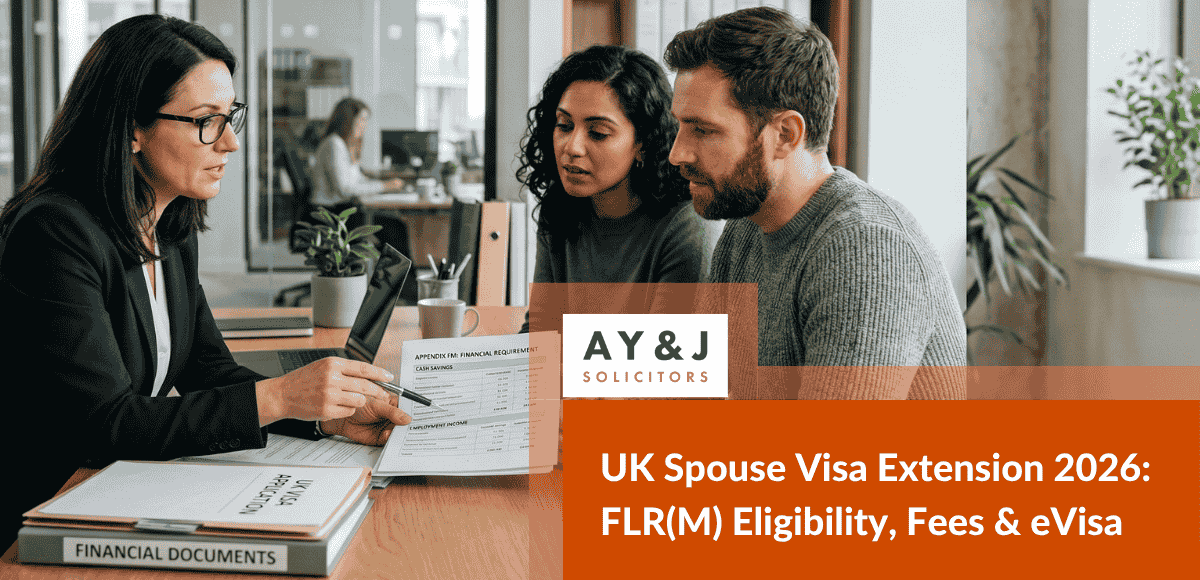
Your initial UK Spouse Visa lasts either 30 or 33 months. Before that period ends, you must apply for a UK Spouse Visa Extension. If you do not, your lawful right to remain in the UK expires with it, and the consequences are difficult to reverse.
This UK Spouse Visa Extension is a formal, substantive review of your life in the UK. Broadly speaking, the requirements mirror your initial application, with two key differences: the English language level steps up, and, importantly, your own UK income can now count toward the financial threshold.
- Visa Extension: The application is a 30-month Spouse visa extension
- Financial threshold: £29,000 for most applicants in 2026 and £18,600 if you entered the route before 11 April 2024
- English requirement: Level A2, one step up from your initial visa
- Cohabitation evidence: 6 joint documents or 12 individual documents, from at least 3 sources
- Cost: £3,908.50 per person (application fee + Immigration Health Surcharge)
- When to apply: Before your current visa expires, and no more than 28 days early
- eVisa: BRP cards expired 31 December 2024. Your status is now fully digital
One significant change for 2026: physical Biometric Residence Permit (BRP) cards are no longer issued or valid. All BRPs expired on 31 December 2024. Immigration status is now held entirely online through an eVisa, accessed via a UKVI account. If you have not yet created your UKVI account, do so now at the official eVisas page.
Here is everything you need to know to prepare and submit a strong application.
What is FLR(M)?
FLR(M): Further Leave to Remain (Marriage) is the official name for the UK Spouse Visa Extension. It is a mandatory application that grants a further 30 months in the UK, the halfway point on the five-year route to Indefinite Leave to Remain (ILR).
Table of Contents
How Does the UK Spouse Visa Extension FLR(M) Work?
The extension stage is not always a formality. It is a substantive review of whether your relationship is genuine and ongoing, whether you continue to meet the financial and accommodation requirements, and whether your English has progressed as expected.
Unlike the initial UK Spouse Visa application, which focuses on your relationship from abroad, this stage examines whether you have built a continuous shared life in the UK since you arrived.
Relationship Evidence: Proving Your Ongoing Life Together
At the UK Spouse Visa Extension stage, cohabitation evidence is one of the most common causes of refusal. The Home Office wants to see a consistent, unbroken paper trail rather than a bundle of documents clustered around a single period. Specifically, caseworkers look for evidence that is spread evenly across the entire period since your last visa was granted.
Why This Is Required
The Home Office requires documentary evidence that your relationship is genuine and still ongoing. Specifically, the extension stage focuses on cohabitation: Did you actually live together throughout the entire period since your last visa was granted?
The 6 & 12 Document Rule
The requirement scales based on what correspondence you have available. In practice, most applicants fall into one of three categories.
- If all documents are in joint names, meaning both names appear on the same letter at the same address, you need a minimum of 6 items.
- If you have no joint correspondence and everything is in individual names, you need 12 items in total: 6 in your name and 6 in your partner’s name, both showing the same address.
- If you have a mix of joint and individual documents, one joint document counts as two individual documents. For example, four joint items plus two items each individually add up to the required total.
What Qualifies as Acceptable Evidence
Strong evidence includes council tax bills, bank statements, utility bills (gas, electric, water), GP or NHS letters, HMRC correspondence, and tenancy or mortgage statements. Each document must clearly show your shared address.
By contrast, personal letters, birthday cards, and social media screenshots do not carry sufficient weight as standalone evidence. They can support a strong bundle, but they cannot substitute for official documentation.
Proving You Live Together: The 6 & 12 Document Rule
Choose one of three options
Must come from at least 3 different sources. Dates must be spread evenly across the full period since your last visa was granted.
UK Spouse Visa Extension Financial Requirement: Which Threshold Applies to You?
Financial evidence is the most common reason the Home Office refuses FLR(M) applications. In most cases, applicants have sufficient income. The issue is that they submit evidence incorrectly or apply the wrong threshold entirely.
The Standard Threshold: £29,000
For applicants who entered the UK Spouse Visa Extension route on or after 11 April 2024, the minimum gross annual income required is £29,000. This applies to both the sponsor’s income and, at extension stage, the applicant’s own UK income as well.
Transitional Protection: £18,600
If, however, you entered the route before 11 April 2024, the previous threshold of £18,600 applies, and this protection carries through to the extension stage. You are therefore not required to meet the higher threshold.
Exception: If your UK partner receives PIP, DLA or Carer’s Allowance, a separate adequate maintenance test applies instead. Specialist advice is recommended.
The Adequate Maintenance Exception
If the UK-based sponsor receives specified disability benefits, including Personal Independence Payment (PIP), Disability Living Allowance (DLA), or Carer’s Allowance, neither income threshold applies. Instead, a net income calculation compares combined household income after housing costs against the applicable income support rate. This is a substantially different calculation, and specialist advice is strongly recommended.
A Key Change at Extension Stage: Your Income Now Counts
At the extension stage, applicants can rely on their own UK income in addition to the sponsor’s. For couples where the applicant has been working since arriving in the UK, this can therefore make a material difference to meeting the threshold. Additionally, eligible cash savings held overseas may also count in certain circumstances.
English Language: Moving Up to A2
Why the Level Increases
The UK immigration framework treats English proficiency as a progression that reflects integration at each stage of the partner route. Consequently, each application requires a higher level: from entry, through extension, to settlement.
For the FLR(M) extension specifically, the required level is A2, one step above the A1 level required at the initial visa stage. In practical terms, A2 reflects basic conversational ability: understanding familiar phrases and communicating in routine everyday situations.
Your English Level Roadmap
The requirement steps up at each stage of the route
💡 Tip: Sitting B1 now satisfies the ILR and citizenship English requirement. One test, not two.
🌍 Exempt: Nationals of majority English-speaking countries (USA, Australia, Canada etc.) do not need to sit a test.
How to Meet the Requirement:
There are three ways to satisfy the English language requirement for your UK Spouse Visa Extension.
- Take an approved test: The Home Office maintains a list of approved Secure English Language Tests (SELTs). Providers include Trinity College London and the IELTS SELT Consortium. The test must reach A2 level in both speaking and listening. Costs typically sit between £150 and £200.
- Hold a qualifying degree: Alternatively, a degree-level qualification taught and assessed entirely in English satisfies the requirement, subject to confirmation from the academic institution.
- Qualify for an exemption: Nationals of majority English-speaking countries, including the USA, Australia, Canada, and New Zealand, are automatically exempt. Applicants aged 65 or over are also exempt.
A Practical Note on Timing: Many immigration solicitors recommend sitting at B1 level rather than A2. B1 is required at the ILR stage and for the English component of the British citizenship application. As a result, passing B1 now avoids a second test fee entirely and removes one step from the road ahead.
UK Accommodation: Meeting the Home Office Standard
What “Adequate” Means
The Home Office assesses accommodation against two criteria. First, it must not be overcrowded within the meaning of the Housing Act 1985. Second, and equally, it must meet applicable public health and safety standards.
Evidence Required
Acceptable evidence includes a signed tenancy agreement, a current mortgage statement, or a letter from the landlord confirming your right to occupy. If you are living with family or friends, you must additionally provide a signed letter from the owner or leaseholder confirming the arrangement.
Timing
Accommodation must already be in place at the time of application. Importantly, the Home Office does not accept confirmation of a property you intend to move into at a future date.
UK Spouse Visa Extension Fees and Costs in 2026
Two payments are mandatory for every UK Spouse Visa Extension applicant. Both are due upfront at the point of submission.
The Home Office application fee is £1,321 per person, up from £1,258 in April 2025. The Home Office does not refund this fee if they refuse your application or if you withdraw it.
The Immigration Health Surcharge (IHS) is £2,587.50 per person, calculated at £1,035 per year for a 30-month grant of leave. You pay it in full upfront, and it covers NHS access throughout your visa period. Unlike the application fee, however, the Home Office refunds the IHS if they refuse your application.
Total mandatory cost: £3,908.50 per person, before legal fees or any optional services.
Mandatory Costs: What You Must Pay
Two unavoidable payments, due upfront when you apply
Priority processing is currently unavailable for FLR(M) applications. Standard processing takes approximately 8 weeks from your biometrics appointment.
A note on priority processing: the Home Office has suspended the standard 5-day priority service for UK Spouse Visa Extension applications. The super priority service (next working day decision, +£1,000) may be available depending on circumstances. Standard processing takes approximately 8 weeks from your biometrics appointment.
When to Apply: Getting the Timing Right for Your UK Spouse Visa Extension
The Risk of Applying Too Late
If you apply after your visa has expired, your lawful status ends immediately. The consequences include potential overstaying, loss of the right to work, and a possible reset of the five-year route to settlement. This is, moreover, an entirely avoidable outcome.
The Risk of Applying Too Early
Submitting more than 28 days before your expiry date can result in your new 30-month period being calculated from the grant date rather than your previous expiry. As a result, you may need a third extension application to complete the five-year qualifying period.
The optimal window: within 28 days before your current visa expires.
Your Legal Status While You Wait
Provided you submit your application before your visa expires, the Home Office automatically extends your right to remain in the UK while they process it. You can therefore continue to live and work in the UK on the same conditions as your current visa until a decision is made.
Legally, this is known as Section 3C leave. In practice, an in-time application preserves your lawful status throughout the entire waiting period.
Why UK Spouse Visa Extensions Are Refused
Refusals at the extension stage are more common than many applicants expect. Furthermore, the reasons are rarely about the genuineness of the relationship. They are almost always technical. In fact, most refusals come down to one of five recurring patterns. Here are the most common causes.
Financial Evidence Mismatch
Payslips that do not correspond to bank deposits, income periods calculated incorrectly, or reliance on income sources not permitted under the rules. The Home Office cross-references every figure, and any inconsistency across documents gives them grounds for refusal. In short, the evidence must be internally consistent across every document submitted.
Wrong Financial Threshold Applied
Applicants who entered the route before April 2024 apply the £29,000 threshold unnecessarily and cannot meet it. Others attempt to use £18,600 when the higher rate applies. Consequently, knowing which threshold applies to your specific circumstances is not optional.
Gaps in Cohabitation Evidence
Documents that do not cover the full period since the last visa was granted, or that cluster around one period and leave another unaccounted for, raise questions the Home Office will not overlook. Notably, this is one of the most common causes of refusal.
Incorrect English Language Evidence
An A1 certificate submitted where A2 is required, a test provider not on the Home Office’s approved SELT list, or an expired certificate. In each of these cases, the Home Office issues an automatic refusal on the English language ground.
Late Applications or Overstaying
An application submitted after the visa expiry date does not benefit from the protections that apply to in-time applications. Notably, the consequences here are difficult to reverse, and the impact on the five-year qualifying period can be significant.
Your Next Step: The Path to Permanent Residency
A successful UK Spouse Visa Extension puts you at the halfway point. You have demonstrated your relationship, your finances, and your English once more. The next milestone, Indefinite Leave to Remain, is now 30 months away.
After a further 30 months, provided you continue to meet the requirements and maintain a clean immigration record, you will become eligible to apply for Indefinite Leave to Remain (ILR): the permanent right to live and work in the UK, without time limits, without renewals, and without conditions.
Following ILR, most applicants become eligible to apply for British citizenship after one further year. This is another reason to consider sitting B1 now rather than A2: it removes one step from the road ahead.
How Your Current Pathway Looks:
Spouse Visa (30 to 33 months) → FLR(M) Extension (30 months) → ILR → British Citizenship
Getting this extension right is not just about the next 30 months. It protects every stage that follows.
How A Y & J Solicitors Can Help
A Y & J Solicitors is a specialist immigration law firm regulated by the Solicitors Regulation Authority (SRA) and recognised in the Legal 500. Our team has prepared more than 5,000 immigration applications, with a 98% success rate across spouse and partner visa cases.
At the UK Spouse Visa Extension stage, technical errors in financial evidence, cohabitation documents, or English language submissions are the primary cause of refusal. Consequently, professional preparation makes a measurable difference.
We offer:
- A full eligibility assessment, including confirmation of which financial threshold applies to your circumstances
- Review of your cohabitation evidence before submission to identify any gaps
- Preparation and submission of your complete application
- Ongoing case management throughout the processing period
Get in touch today for a free initial consultation with a member of our immigration team.