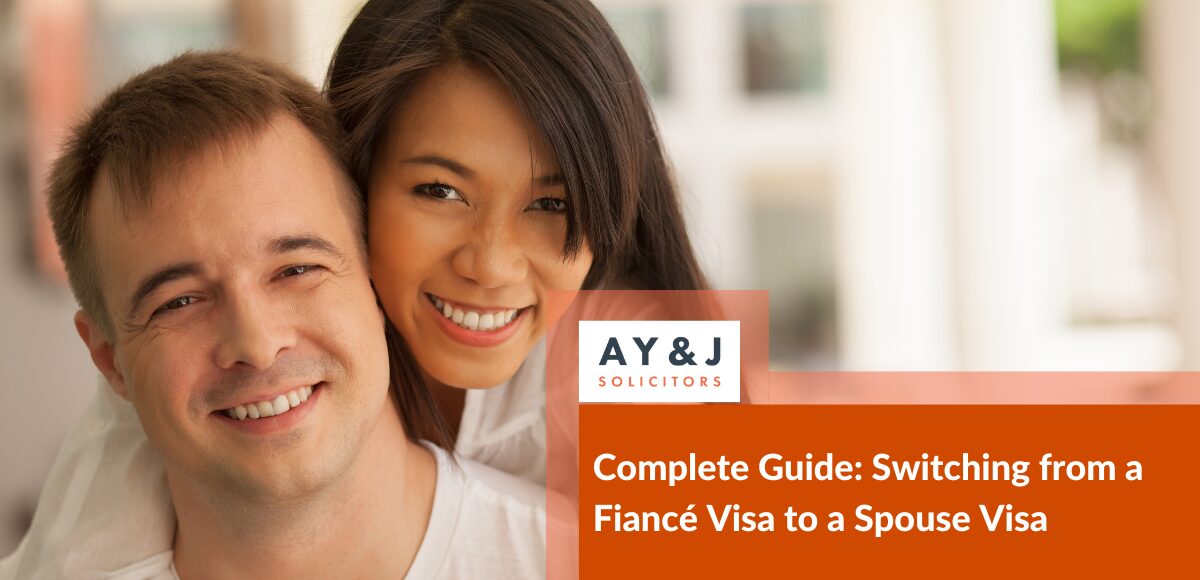
You can switch from a Fiancé Visa to a Spouse Visa without leaving the UK. You apply from inside the UK once you are married, and before your Fiancé visa expires. Get the timing wrong, though, and a missed deadline or a gap in your financial evidence can sink a strong application. Switching from a Fiancé Visa to a Spouse Visa unlocks the right to work and starts your route to settlement.
Switching visas after marriage in the UK follows one clear window, and this guide walks you through it. You will learn who qualifies, what you need, what it costs, and what changes once you switch.
| Question | Answer |
| Can you switch? | Yes, from inside the UK |
| When? | After marriage, before your Fiancé visa expires |
| Do you have to leave the UK? | No |
| Does it count towards settlement? | Yes, from the date of grant |
Table of Contents
Can You Switch from a Fiancé Visa to a Spouse Visa?
Yes. You apply for your Spouse visa inside the UK, with no need to travel home to do it. Switching from a Fiancé Visa to a Spouse Visa keeps you in the country from start to finish.
Two conditions decide whether you can apply. You must already be married or in a civil partnership, and your Fiancé visa must still be valid. You cannot change a Fiancé visa to a Spouse visa before the wedding, nor switch from a Fiancé visa to a Spouse visa UK-wide once it has expired.
Our guide to switching to a spouse visa from inside the UK covers the same timing window in more depth.
- A valid, unexpired Fiancé or Fiancée visa
- A marriage or civil partnership recognised in the UK
- A genuine, subsisting relationship
- A sponsor who is British or settled
- The financial and English requirements met
What Changes When You Switch to a Spouse Visa?
Switching from a Fiancé Visa to a Spouse Visa changes your status from temporary to long-term. The Fiancé visa is a short, work-restricted permission to marry. The Spouse Visa is a longer, working visa that leads to settlement.
| Fiancé Visa | Spouse Visa |
| Cannot work | Can work |
| 6 months | 30 months |
| Cannot be extended | Can be extended |
| No route to settlement | Counts towards settlement |
| For marrying only | For long-term residence |
Eligibility Requirements
Switching from a Fiancé Visa to a Spouse Visa means meeting the partner rules in full. You must satisfy each requirement below on the date you apply.
Valid Fiancé visa
Your Fiancé visa must not have expired. Apply while it remains valid, even if the decision arrives later.
Marriage or civil partnership
You must be legally married, or in a civil partnership recognised under UK law. A religious ceremony alone may not be enough.
Genuine relationship
The Home Office must be satisfied your relationship is genuine and subsisting. Evidence of a shared life carries more weight than any single document. Joint finances, a shared address, and photographs over time all help build that picture.
Financial requirement
Your sponsor must meet the minimum income requirement, set out below. You can meet it in one of three ways.
How to meet the financial requirement
Meet it through any one of these three routes.
£29,000
Sponsor’s gross annual income
£88,500
Held for at least 6 months
Income + savings
Lower income topped up with savings
Note: the £29,000 threshold is a flat rate. There is no longer an extra amount for children.
English language
You must show English at CEFR level A1. The A1 certificate from your Fiancé visa is usually still valid, so most applicants avoid a second test.
Accommodation
You need suitable accommodation for you and your partner. It must not be overcrowded, and you must not rely on public funds.
Documents Required
Gather your evidence before you open the form. A Fiancé visa Spouse visa application usually stumbles on paperwork, not facts. Applicants who switch a Fiancé visa to a Spouse visa lose most time to missing or inconsistent documents.
| Document | What it shows |
| Passport | Identity and current visa |
| BRP or eVisa | Your existing permission |
| Marriage or civil partnership certificate | Your legal union |
| Financial evidence (payslips, bank statements) | The income or savings requirement |
| English certificate | Your A1 qualification |
| Accommodation proof | Where you will live |
| Relationship evidence | A genuine, shared life |
How to Switch from a Fiancé Visa to a Spouse Visa
You apply for a Spouse visa after your Fiancé visa using the FLR(M) form, the in-country partner application. Work through it in order.
- Marry or form your civil partnership within the six-month window.
- Gather your documents and check them against the rules.
- Complete the FLR(M) application online.
- Pay the application fee and health surcharge.
- Book and attend your biometrics appointment.
- Upload your supporting evidence.
- Wait for the decision, then receive your eVisa.
Costs and Processing Times
Switching from a Fiancé Visa to a Spouse Visa carries three main costs. You pay the Home Office application fee for the in-country partner route, the Immigration Health Surcharge for the length of your visa, and an optional super priority fee if you want a faster decision.
Fees change most years, so confirm the current amounts on the GOV.UK visa fees page before you budget. How long you wait then depends on the service you choose.
Your switch timeline
From wedding day to the start of your settlement clock.
Marry
Within your 6-month window
Apply
Before your Fiancé visa expires
Biometrics
Attend and upload documents
Decision
Around 8 weeks,or next day with super priority
Granted
Your 5-year settlement clock starts
Miss the deadline and you may have to leave the UK and start again. Apply in time.
Before you submit, know the errors that most often derail these applications.
Common Mistakes That Cause Refusals
Most refusals come from avoidable errors, not from weak relationships.
- Applying before the marriage has legally taken place
- Applying after the Fiancé visa has expired
- Financial evidence that does not match the specified rules
- Weak, or overcrowded, accommodation evidence
- Using an English qualification that does not meet A1
- Relationship documents that contradict each other
- Travelling outside the UK after you apply
If a decision goes against you, our team can review it. We will advise on a fresh application or a spouse visa appeal.
What Happens After You Switch?
Approval brings the rights the Fiancé visa withheld. You can work, study, and use the NHS, and your Spouse visa after marriage in the UK runs for 30 months. You extend it once at the halfway point, then apply for indefinite leave to remain after five continuous years.
Time on the Fiancé visa does not count towards those five years. The clock starts the day your Spouse Visa is granted, which is why applying promptly protects your timeline.
Frequently Asked Questions
Can I work while waiting for a decision? Yes. Once you apply in time, your conditions continue under Section 3C leave until the Home Office decides.
Can I leave the UK during the application? No. Travelling after you apply can cause the application to be treated as withdrawn.
Can I switch after my Fiancé visa expires? No. You must apply for a Spouse visa after your Fiancé visa while it is still valid.
Do I need another English test? Usually not. The A1 certificate from your Fiancé visa is normally accepted.
Can I include children? Yes. Dependent children can be added, each with their own fee and evidence.
Can I use savings instead of salary? Yes. Savings held for at least six months can meet or top up the requirement.
What if my application is refused? You may be able to reapply, request a review, or appeal, depending on the reason.
How A Y & J Solicitors Can Help
Switching from a Fiancé Visa to a Spouse Visa is straightforward when it is planned, and costly when it is rushed. A Y & J Solicitors has guided couples through the partner routes for over 15 years. Our Legal 500 ranked, SRA regulated team has handled more than 5,000 cases.
We check your eligibility, pressure-test your financial evidence, and build your FLR(M) application to meet the rules first time. Whether you are about to marry or racing a deadline, you can book an initial consultation with us.