Disclaimer: The information in this blog is accurate as of its publication date. Any updates after that date are not reflected here.
Quick Summary:
Why Sponsor Licences are Now at Higher Risk Than Ever
The Home Office has shifted from periodic licence renewals to continuous, enforcement-led compliance monitoring. As a result, sponsor licence suspension and revocation numbers have reached record levels.
What UK sponsors must know now:
- Sponsor licence suspensions and revocations rose sharply between April 2024 and March 2025.
- Civil penalties for illegal working now reach £45,000 for a first breach and £60,000 for repeat breaches.
- Care, hospitality, construction and smaller professional services firms face heightened scrutiny.
- A ten year sponsor licence does not reduce compliance risk. It increases it.
If you have received a Home Office compliance letter or suspension notice, early legal advice is critical.
Table of Contents
How the Sponsor Licence System Changed in 2024 and 2025
1. From Four Year Renewals to Ten Year Licences
Until April 2024, sponsor licences required renewal every four years. That renewal requirement has now been removed.
Sponsor licences that expired on or after 6 April 2024 were automatically extended to a ten year validity period. No renewal application or renewal fee is required.
This change does not mean ten years without checks. The Home Office has publicly confirmed that staff previously handling renewals were reallocated to compliance and enforcement work. For most sponsors, this means more audits, not fewer.
Some routes, including UK Expansion Worker and Scale up licences, still have shorter maximum durations.
2. Higher Salary Thresholds and Fewer Eligible Roles
The eligibility framework for sponsored roles has tightened significantly.
Key changes sponsors must account for:
- The Shortage Occupation List was fully replaced by the Immigration Salary List in April 2024.
- From 22 July 2025, the general Skilled Worker salary threshold increased to £41,700 and 100 percent of the occupation going rate, whichever is higher.
- Most new Skilled Worker roles are now expected to be at RQF Level 6 or above, with limited exceptions.
Misusing salary discounts or sponsoring roles that are not genuinely skilled is now a common trigger for sponsor licence suspension.
3. Civil Penalties and Criminal Exposure for Illegal Working
Civil penalties for illegal working increased sharply from February 2024. Current penalty levels are:
- Up to £45,000 per illegal worker for a first breach.
- Up to £60,000 per illegal worker for repeat breaches.
Right to work failures now regularly lead to both civil penalties and sponsor licence action. The Home Office is far less tolerant of procedural errors than in previous years.
Why Sponsor Licences are Being Suspended and Revoked in Record Numbers
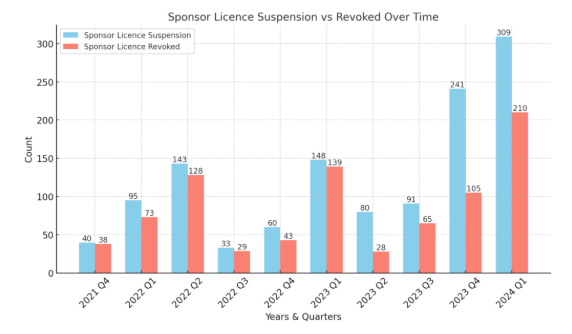
Home Office transparency data and public statements confirm that enforcement activity reached record levels during 2024 and 2025. Between April 2024 and March 2025, more than 1,700 sponsor licences were suspended and over 1,500 were revoked. Later figures show revocations continuing to rise into mid-2025.
A major driver has been enforcement in the care sector. More than 470 care providers lost sponsor licences in connection with exploitation and abuse concerns, affecting tens of thousands of sponsored workers. However, enforcement has expanded beyond care into hospitality, transport, construction and professional services. The common theme is weak systems rather than deliberate abuse.
Key Sponsor Duties in 2026 That Businesses are Still Getting Wrong
1. Reporting Duties
Sponsors must report key changes through the Sponsor Management System within strict deadlines.
This includes changes to:
- Job title, duties, salary or working hours.
- Work location, including hybrid or remote patterns.
- Corporate structure, ownership or key personnel.
Late or missed reports remain one of the most frequent compliance failures.
Record Keeping and HR Systems
Sponsors must maintain clear, accessible records for each sponsored worker. This includes:
- Right to work checks.
- Contracts, payslips and payroll records.
- Absence records and contact details.
- Evidence supporting the role and salary level.
Inability to produce records during an audit is treated as a serious breach.
Right to Work Checks and Preventing Illegal Working
Right to work compliance now sits at the centre of sponsor enforcement. Failures often lead to:
- Civil penalties.
- Licence downgrades.
- Suspension or revocation following inspection.
Sponsors must ensure checks are carried out correctly, recorded properly and repeated where required.
Remote, Hybrid and Third Party Working
Remote and hybrid working is permitted, but it must be justified and reported correctly. Sponsors must be able to explain:
- Why the role requires UK presence.
- How duties are monitored.
- Where work is actually carried out.
Unclear arrangements are increasingly flagged during audits.
What Happens if Your Sponsor Licence is Suspended
A sponsor licence suspension notice is issued in writing and takes immediate effect. While suspended:
- You cannot assign new Certificates of Sponsorship.
- Pending CoS requests are paused.
- The Home Office investigates alleged breaches.
Sponsored workers can usually continue working during suspension. However, revocation remains a real risk if issues are not addressed convincingly.
First 48 Hours Checklist When Your Sponsor Licence is Suspended
Sponsors should act immediately and strategically. Within the first 48 hours:
- Read the suspension letter carefully and log all deadlines.
- Freeze non essential sponsorship activity and new hires.
- Inform senior stakeholders and preserve evidence.
- Gather HR, payroll, recruitment and right to work records.
- Instruct a specialist sponsor licence solicitor to prepare representations.
- Communicate carefully with sponsored workers to avoid panic.
Poor early handling often worsens outcomes.
Common Home Office Findings and How to Fix Them Before an Audit
Failure to Report Changes on Time
- What the Home Office sees: Uncontrolled sponsorship.
- What compliant sponsors show: Clear reporting workflows and audit trails.
Poor Record Keeping
- What the Home Office sees: Inability to verify compliance.
- What compliant sponsors show: Organised, accessible digital records.
Unprepared Key Personnel
- What the Home Office sees: Lack of ownership and understanding.
- What compliant sponsors show: Trained Authorising Officers and Level 1 users.
Certificates of Sponsorship Not Matching Reality
- What the Home Office sees: Non genuine roles.
- What compliant sponsors show: Accurate role descriptions and salary evidence.
Sector Spotlight: Where We See the Highest Sponsor Licence Risk
1. Health and Social Care
High enforcement following exploitation findings and rapid licence revocations.
2. Hospitality, Construction and Transport
High turnover, tight margins and weaker HR systems increase risk.
3. Smaller Professional Services and Tech Firms
Roles near skill or salary thresholds are vulnerable following RQF Level 6 changes.
Case Study: From Suspension Risk Back to an A Rating
A medium sized UK sponsor faced suspension following a compliance visit that exposed late reporting and weak right to work records. A Y & J conducted an urgent systems review, drafted detailed representations, retrained key personnel and implemented new compliance controls.
The licence was retained without revocation, and the sponsor returned to an A rating with improved audit readiness.
Critical Sectors Facing ages Amid the Rise in Sponsor Licence Suspensions & Revocations
As the immigration rules become stringent, there is a rise in suspensions and revocations of sponsor licences, and the grip has begun to tighten on several industries. Businesses already dealing with the problem of bridging the critical skill gap in their workforce are feeling the impact of the sponsor licence suspension. The sectors that heavily rely on international talent will feel this sharply.
Wherever it may be, whether in healthcare or engineering, IT or skilled trades, such shortages of qualified professionals only worsen workforce gaps, making companies vulnerable to operational disruptions and risks related to regulatory compliance. Knowing which sectors are damaged by these shortages can help organisations navigate such a challenging landscape and protect their access to the global talent pool.
The Shortage Occupational List (SOL) lists occupations in sectors within the UK that have skill shortages. The ‘Immigration Salary List‘ replaced the SOL. The number of eligible roles under this list has fallen dramatically. For example, all engineering and technology vocations have been removed from the list. Moreover, Home Office still applies lower going rates for roles already holding sponsorship. However, this may be higher than their current pay rate, provided they remain with they were on a Skilled Worker visa prior to these changes.
How A Y & J Solicitors Help You Safeguard Your Sponsor Licence
When sponsor-licence rules tighten, you need a partner who understands the real-world impact on your business. For more than 15 years, A Y & J Solicitors has tackled hundreds of sponsor licence compliance challenges, maintained a 95% success rate and guided over 5,000 visa and immigration cases. We explain Home Office requirements in straight-talk, support you through every step—from your first licence application to mock audits and ILR planning and treat your case with the undivided care it deserves. Moreover, our place in The Legal 500 proves we deliver on our promises. If you want clear advice, practical help and a sponsor-licence safeguard you can trust, reach out to us.
Frequently Asked Questions About Sponsor Licence Suspension and Revocation
1. How Do I Know if My Sponsor Licence is Suspended or Revoked?
The Home Office will notify you formally in writing through the Sponsor Management System and by email.
2. Can I Assign Certificates of Sponsorship While Suspended?
No. All CoS assignments are blocked during suspension.
3. How Long Do I Have to Respond to a Suspension Notice?
The deadline is set out in the notice and is usually short. Missing it can lead to revocation.
4. What Happens to Sponsored Workers if My Licence is Revoked?
Their visas are curtailed, and they must find a new sponsor or leave the UK.
5. Do I Still Need to Renew My Sponsor Licence?
No. Under the current ten year system, renewal applications are no longer required for most sponsors.
Accurate as of December 2025. Immigration rules and enforcement practices change frequently. Always check the latest Home Office guidance or seek legal advice before acting.