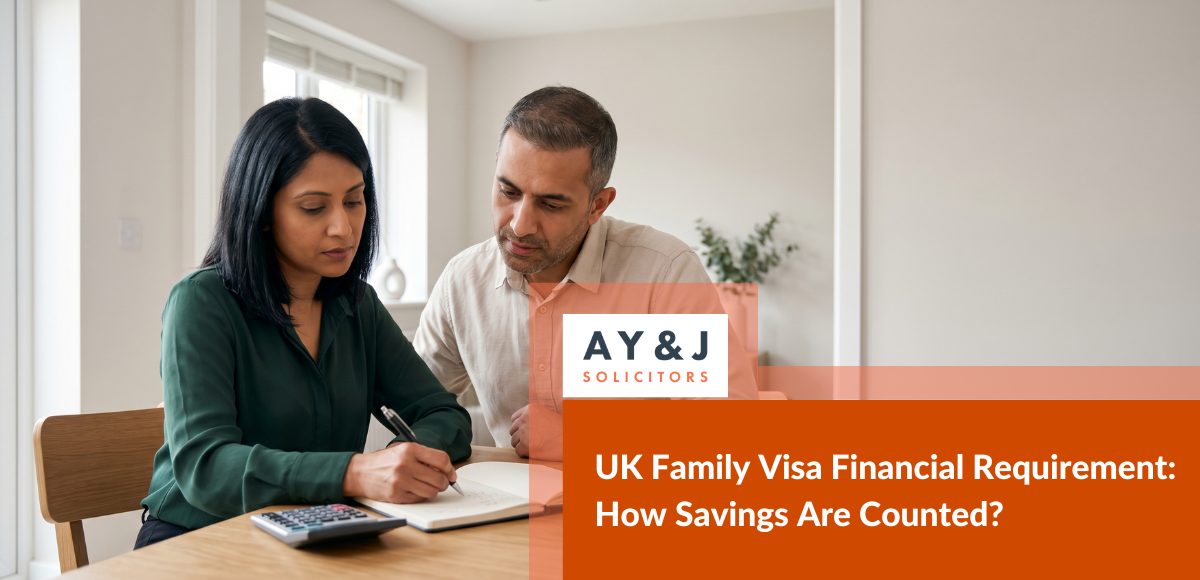
The UK family visa financial requirement sets a minimum income threshold of £29,000 for most new applications. However, when you cannot meet that income threshold through earnings alone, cash savings provide an alternative route. Specifically, the Home Office uses a specific statutory formula to calculate the cash savings you need to meet the financial requirement.
- Income threshold: £29,000 applies to most new applications. Notably, transitional provisions may protect those who applied before 11 April 2024, with £18,600 as the applicable figure.
- The statutory formula: Savings required = £16,000 + (2.5 × income shortfall). For example, if your annual income is £20,000, then your income shortfall is £9000.
- Eligible funds only: You must hold savings in regulated, accessible accounts, under specific ownership conditions, for a continuous qualifying period.
- Combination restrictions: Cash savings can supplement income shortfalls, provided your primary income derives from a permitted income category.
In short, this guide covers the mechanics of the UK family visa financial requirement: the applicable thresholds, the savings calculation formula, eligible account types, the 6-month holding rule, and the evidence you must submit before you apply.
Table of Contents
The UK Family Visa Financial Requirement
The Home Office requires family visa applicants to demonstrate sufficient financial resources to support themselves without recourse to public funds. Specifically, this requirement applies across the primary family routes under Appendix FM of the Immigration Rules: the Spouse visa, Civil Partner visa, Unmarried Partner visa, and Fiancé visa.
You must meet the UK family visa financial requirement at every stage: the initial entry application, the FLR(M) extension at 2.5 years, and settlement at 5 years. Notably, failure to meet it is one of the most common grounds for family visa refusal.
Applicable Thresholds
Two distinct thresholds operate simultaneously in 2026, depending on when you first submitted a partner visa application.
New Applications: £29,000
For applications submitted on or after 11 April 2024, the minimum threshold is £29,000 gross per year. Importantly, this figure remains unchanged regardless of the number of dependent children you include. Furthermore, no child uplift applies under the current framework.
Transitional Route: £18,600
If you submitted your first application before 11 April 2024, transitional arrangements protect you when extending or settling with the same partner. Specifically, the applicable threshold is £18,600 gross per year, with child uplifts of £3,800 for the first child and £2,400 for each additional child.
Which Threshold Applies to You?
Check your first application date
Satisfying the UK Family Visa Financial Requirement
For most sponsors, employment income is the primary route. Specifically, if the gross annual salary meets or exceeds the threshold, employment evidence alone satisfies the UK family visa financial requirement. The required evidence includes payslips, bank statements, and an employer letter confirming salary and contract type.
When Employment Income Is Insufficient
When employment income falls short of the threshold, Category D of Appendix FM-SE permits the use of cash savings to supplement the shortfall or to meet the requirement entirely.
However, not every income type permits you to combine savings with it. Specifically, whether you can combine cash savings depends entirely on which income category applies to your sponsor.
Income Source Combination Rules
The Home Office strictly determines which income categories you can combine with cash savings under the UK family visa financial requirement. Notably, applying savings to an ineligible income type is one of the most significant and avoidable preparation errors on this route.
Permitted Combinations
You may combine cash savings with the following income sources to offset a shortfall:
- Category A (salaried or non-salaried employment): Your sponsor has been with the same employer for 6 months or more. You can combine employment income from this category with savings.
- Category B (recent employment): Your sponsor has been with their current employer for less than 6 months. Importantly, savings can only supplement the current annualised salary figure. Specifically, you cannot calculate or rely on the total income earned over the last 12 months, only the annual salary of the current job.
- Category C (non-employment income): You can combine rental income, dividends, interest payments, and royalties with savings.
- Category E (pension income): You can combine state or private pension income with savings.
Prohibited Combinations
Conversely, you cannot combine cash savings with the following income sources:
- Self-employment income (Categories F and G)
- Income as a director or employee of a specified limited company
The prohibition exists to prevent double-counting. Specifically, business revenue can move between a business account and a personal account, and accordingly, the Home Office does not permit this combination. Without the restriction, an applicant could present the same funds simultaneously as income and as discrete personal savings.
| Income source | Can combine with savings? |
|---|---|
| Salaried employment, same employer 6+ months | Yes |
| Recent employment, under 6 months (Part 1) | Yes |
| Recent employment, 12-month earnings total (Part 2) | No |
| Non-employment income (rental, dividends) | Yes |
| Pension | Yes |
| Self-employment | No |
| Specified limited company income | No |
Calculating Required Savings: The Statutory Formula
The required savings figure does not equal the income shortfall. Rather, it is substantially higher because the Home Office applies a specific statutory formula rather than a direct 1:1 comparison.
The £16,000 Base Threshold
The formula automatically excludes the first £16,000 of savings from the assessment. Specifically, this figure represents the threshold at which individuals in the UK generally become ineligible for income-related state benefits. Consequently, the Home Office treats this amount as basic living costs and excludes it from the visa calculation entirely.
The 2.5 Multiplier
The Home Office then divides any savings above £16,000 by 2.5. Notably, this divisor reflects the 30-month duration of the initial visa grant, converting the lump sum into an annualised income equivalent.
The Formula: Savings required = £16,000 + (2.5 × income shortfall)
The Savings Formula
How the Home Office calculates the cash requirement
Formula Application: Worked Examples
| Your income | Shortfall vs £29,000 | Calculation | Minimum savings needed |
|---|---|---|---|
| £0 | £29,000 | £16,000 + (2.5 × £29,000) | £88,500 |
| £20,000 | £9,000 | £16,000 + (2.5 × £9,000) | £38,500 |
| £24,000 | £5,000 | £16,000 + (2.5 × £5,000) | £28,500 |
| £27,000 | £2,000 | £16,000 + (2.5 × £2,000) | £21,000 |
| £29,000+ | £0 | No formula needed | None required |
Qualifying Savings: Eligibility Criteria
Not all funds qualify under Category D of the UK family visa financial requirement. Specifically, the Home Office imposes specific requirements regarding account type, ownership, and accessibility. Notably, a correct calculation supported by funds you hold in the wrong account or under the wrong name will not satisfy the requirement.
Accounts and Funds That Qualify
You must hold eligible savings in accessible accounts at regulated financial institutions:
- Regulated accounts: Current, deposit, or investment accounts at any properly regulated financial institution, UK or overseas, provided it does not appear on the Home Office excluded list.
- Stocks and shares ISAs: Generally accepted under Home Office casework guidance, provided you can access the funds. However, the Immigration Rules do not explicitly list this account type, so if you rely on it, confirm your eligibility with a specialist before submission.
- Joint accounts: Funds you hold jointly with the sponsor, or in either individual’s name, qualify.
The defining requirement is accessibility. Specifically, you must be able to withdraw the funds. Where an account does not permit access before a fixed date under any circumstances, those funds do not qualify.
Accounts and Funds That Do Not Qualify
The Home Office excludes the following from the UK family visa financial requirement regardless of the amount you hold:
- Business accounts: You must hold funds in a personal account. Importantly, even where you are the sole director and the funds are personal in practice, the Home Office does not accept savings held within a corporate account.
- Third-party accounts: Funds held by parents, relatives, or friends do not qualify, regardless of supporting letters or declarations. Specifically, the funds must be in your or your sponsor’s name.
- Inaccessible fixed-term bonds: Where you cannot access funds before a fixed maturity date under any circumstances, they do not qualify. Conversely, accounts that permit early access with a penalty generally qualify.
- Cryptocurrency and digital assets: These fall outside the regulatory requirements for regulated, accessible cash savings.
- Unliquidated assets: You cannot count property equity, pension funds, and non-cash investments directly. However, two specific exceptions apply once you convert these to cash, as set out below.
Gifted Funds
Financial gifts from family members are permissible, provided you have irrevocably transferred the funds to your or the sponsor’s account and held them there for the full 6-month qualifying period before the application date.
Additionally, you must explain the source of any gifted funds in a signed personal declaration from the account holder. Notably, this does not need to be a solicitor’s letter. A written personal statement detailing the origin of the funds is sufficient.
The 6-Month Qualifying Period
The Home Office mandates a continuous 6-month holding period for cash savings, measured from when you deposit the funds into an eligible account to the online application submission date.
Furthermore, if you need additional funds and they are not yet in the account, those funds begin their own 6-month qualifying period from the date you deposit them.
The Minimum Balance Requirement
The Home Office does not use the balance as of the application date, nor does it average the balance over the period. Instead, it uses the lowest balance recorded at any single point during the 6-month window.
For example, if savings reach £88,500 and then fall to £72,000 at any point during the qualifying period, the Home Office treats the qualifying savings as £72,000. Therefore, you must keep the full required balance uninterrupted throughout the entire 6-month period.
Exceptions to the 6-Month Cash Holding Rule
Two specific circumstances permit savings to qualify without a continuous 6-month cash holding period:
- Liquidated investments: Cash from the recent sale of investments, including stocks and shares, ISAs, and bonds, qualifies immediately, provided you held the original asset in your name for at least 6 months before the sale. Specifically, you must provide a portfolio report from a regulated financial institution as evidence, showing the original holdings and the period of ownership.
- Property sale proceeds: Proceeds from a property sale qualify immediately, with no waiting period for the cash itself, provided you owned the property for the relevant period. Notably, you must provide a solicitor’s completion statement as evidence.
Evidence Requirements Under Appendix FM-SE
All documentation you submit in support of the UK family visa financial requirement must therefore conform to the standards set out in Appendix FM-SE. Accordingly, a correct calculation backed by non-compliant documentation will still result in refusal.
- Bank statements: Must cover the full 6-month period and show the account holder’s name, account number, every transaction, and the running balance throughout. Importantly, you must date statements no earlier than 28 days before the online application submission date. Furthermore, electronic statements you download from an online banking application require accompanying written confirmation from the bank that the statements are genuine.
- Source of funds declaration: A signed personal statement from the account holder explaining the origin of the savings. Notably, the caseworker will query any large or unexplained deposit. Therefore, a clear personal statement explaining the source is sufficient.
- Investment or property documentation (where applicable): For liquidated investments, a portfolio report from a regulated financial institution showing the original holdings and ownership period. Likewise, for property sale proceeds, a solicitor’s completion statement and evidence of the original purchase date.
- Accessibility evidence (where applicable): For accounts with notice periods or early withdrawal conditions, documentation confirming that you can still access the funds, such as the account’s terms and conditions confirming that early access is permitted even where a penalty applies.
Submitting the Evidence
You submit the savings documentation alongside the main application through the Home Office online portal. Specifically, the financial requirements section of the form covers evidence of savings. Furthermore, the portal identifies the document types it requires based on your answers.
Before submission, confirm that your bank statements, source of funds declaration, and savings calculation are internally consistent. Notably, the caseworker will identify any discrepancy between these documents during their review.
Pre-Submission Compliance Checklist
Before submitting, confirm each of the following:
- You have applied the correct threshold (£29,000 or £18,600) based on your first application date
- You have applied the statutory formula correctly and calculated the minimum savings figure accurately
- You hold savings in a regulated, accessible account in your or your sponsor’s name
- The balance has remained at or above the required figure continuously for the full 6-month qualifying period
- The balance has not fallen below the required figure at any point during those 6 months
- Bank statements covering the full 6-month period are available and dated within 28 days of the intended submission date
- You have prepared a source of funds declaration for any large or gifted deposits
- If you combine savings with income, the income derives from an eligible category, not self-employment or a specified limited company
If you cannot confirm any item, resolve it before paying the application fee. Notably, a refusal at this stage is entirely avoidable.
How A Y & J Solicitors Can Help
Navigating the UK family visa financial requirement through cash savings requires precision at every step: applying the statutory formula correctly, maintaining continuous balance compliance, and ensuring all documentation meets Appendix FM-SE standards.
A Y & J Solicitors is SRA regulated, recognised in the Legal 500, and has handled more than 5,000 immigration cases with a 98% success rate. Whether you are calculating your savings requirement for the first time or reviewing an application that the Home Office has previously refused, contact us for a free initial consultation.