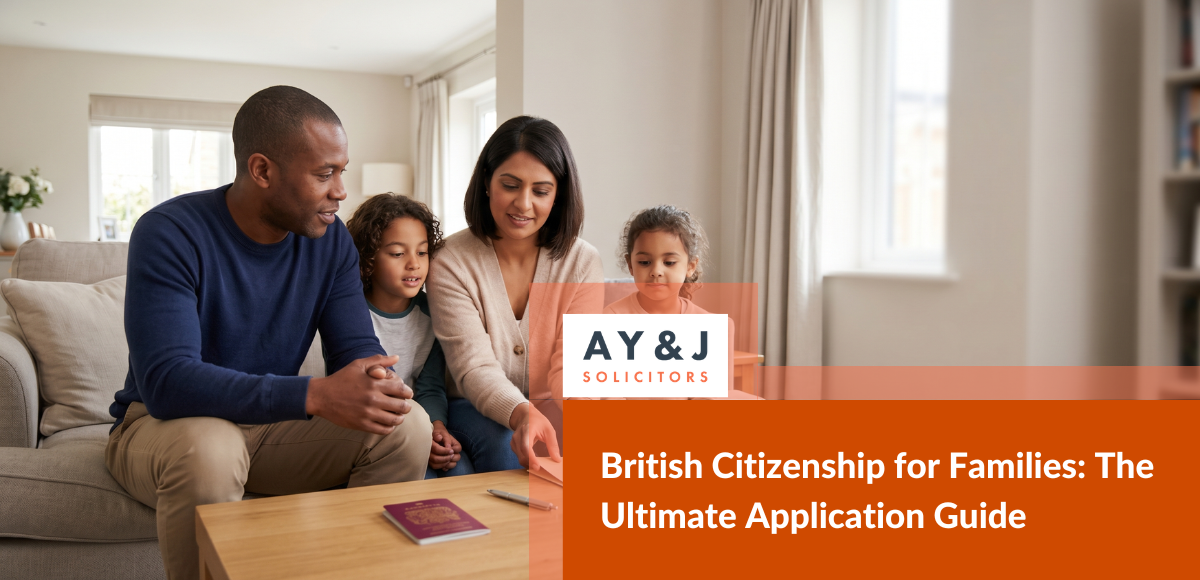
Applying for British citizenship for families means submitting a separate application for every family mApplying for British citizenship for families means submitting a separate application for every family member. Parents naturalise using Form AN. Children under 18 register using Form MN1.
Consequently, the parents’ eligibility determines when the child can apply. Submitting in the wrong order results in a refused application and a forfeited fee. The routes are legally distinct, the requirements differ, and the Home Office charges each person separately.
- Form AN: naturalisation form for parents and adult applicants
- Form MN1: registration form for children under 18
- Sequence matters: the parent must be eligible before the child can apply
- No family rate: the Home Office charges each applicant separately
- Fee waiver: available for children who cannot afford the registration fee
Here is everything you need to know before submitting a British citizenship application for families.
Table of Contents
Check First: Is Your Child Already British?
Before starting any British citizenship for families application, confirm whether your child already holds British citizenship automatically. Specifically, many children acquire citizenship at birth and need no Form MN1 at all.
Born in UK: settled parent
If a parent held British citizenship or indefinite leave to remain at the time of the birth, the child is automatically British. Apply directly for a British passport.
Born in UK: not settled
If the parent was not yet settled at the time of the birth, the child is not automatically British. Consequently, registration via Form MN1 is required once the parent obtains ILR or British citizenship.
Born outside the UK
Citizenship passes automatically only where the British parent is British other than by descent. Furthermore, if the British parent became British through registration or naturalisation, the child must apply via Form MN1.
British Citizenship for Families: The Parents’ Route
The parents’ naturalisation is the first step in any case involving British citizenship for families. Both parents and children must be assessed separately under the British Nationality Act 1981. Specifically, two routes apply depending on whether you have a British citizen spouse.
| Criteria | Section 6(1): Standard route | Section 6(2): Spouse route |
|---|---|---|
| Who this applies to | No British citizen spouse | Married to or in a civil partnership with a British citizen |
| Qualifying period | 5 years | 3 years |
| Total absence limit | 450 days | 270 days |
| Final year limit | 90 days | 90 days |
| ILR requirement | Must hold ILR for at least 12 months | Must hold ILR, no minimum period |
On the Section 6(2) Spouse route, you can apply for naturalisation as soon as you obtain indefinite leave to remain. Accordingly, the spouse route accelerates the whole family timeline by up to a year compared to the standard route.
Registering Your Children: Form MN1
Registration under Form MN1 is the child’s route to British citizenship for families in cases involving children under 18. Children do not naturalise. Consequently, the legal basis, the form, and the Home Office assessment are entirely separate from the parents’ Form AN application.
The eligibility route depends on how and where the child was born. Full details are in the Home Office nationality guidance:
- Section 1(3): a child born in the UK to a parent who has since obtained ILR or British citizenship. The child holds a legal entitlement to register. Accordingly, the Home Office must grant the application if all requirements are met.
- Section 3(1): a child born outside the UK whose parent is applying for naturalisation or has recently naturalised. This is a discretionary route. However, submitting the child’s MN1 at the same time as the parent’s AN application strengthens the case considerably.
- Section 3(2) and 3(5): a child born outside the UK to a British parent who is British by descent. Specific prior residence requirements apply to the parent.
Children aged 10 and over must also satisfy the good character requirement. Specifically, the Home Office assesses any criminal record, cautions, or conduct issues as part of the registration process. For younger children, good character is not assessed.
Furthermore, fee waivers are available for children who cannot afford the registration fee. No equivalent waiver exists for adult naturalisation.
The Right Order: British Citizenship for Families
For British citizenship for families, the sequence of applications matters as much as the eligibility itself. Accordingly, understanding how the children’s and parents’ routes connect is essential before you submit any application.
The parent must satisfy every naturalisation requirement before you submit the child’s Form MN1, because a parent who is not yet eligible cannot anchor a child’s Section 3(1) application. A Y & J Solicitors advises families to follow this sequence:
- Confirm eligibility first. The parent must satisfy every naturalisation requirement before submitting the child’s Form MN1: qualifying period, absence limits, ILR held for the required period, Life in the UK test, and English language requirement.
- Submit both on the same day. Send Form AN for the parent and Form MN1 for each child simultaneously. The Home Office processes them independently but runs them in parallel, so decisions typically arrive together.
- Attend biometric enrolment. Each applicant enrols fingerprints and a photograph, normally within 45 days of submission.
- Wait for the decision. Most applications are completed within 6 months, though timelines vary.
- Complete the ceremony. Adults attend the citizenship ceremony and take the oath of allegiance. Children under 18 are not required to attend and receive their certificate of registration by post.
Family Application Timeline
Synchronising parent and child citizenship applications
Consequently, a child whose parent has not met the naturalisation requirements cannot submit a valid Form MN1 under Section 3(1). Therefore, in every British citizenship application for families, the parents’ eligibility serves as the gateway for the whole family.
Costs for British Citizenship for Families
The Home Office charges for British citizenship for families per person. Adults must hold ILR or settled status before applying for naturalisation. Specifically, there is no family rate and no group discount.
| Criteria | Adult (Form AN) | Child under 18 (Form MN1) |
|---|---|---|
| Application fee | £1,709 | £1,000 |
| Ceremony fee | £130 | Not required (unless child turns 18 during processing) |
| Total | £1,839 | £1,000 |
| Fee waiver | Not available | Available for children who cannot afford the fee |
| Life in the UK test | Required | Not required |
| Good character | Yes | Yes, if aged 10 or over |
For a family of two adults and two children, the Home Office fees total £5,678 from 8 April 2026. Accordingly, this excludes legal fees, translation costs, the Life in the UK test at £50 per attempt, and language testing. Furthermore, fees change periodically, and families should confirm current figures before submitting.
Getting the British Citizenship Application Right
British citizenship for families requires careful planning, coordinated timing, and a clear understanding of each route. An error in any one application does not pause the others, and a refused British citizenship for a family’s application forfeits the fee.
A Y & J Solicitors is SRA regulated, recognised in the Legal 500, and has handled more than 5,000 immigration cases with a 98% success rate. Our team advises on the full British citizenship journey for families: confirming whether children are already British, and submitting coordinated Form AN and Form MN1 applications for every family member. Contact us for a free initial consultation.